
Society of Architectural Historians (2015)
The SAH Annual Meeting is usually an opportunity to travel to, and learn about, a new or at least unfamiliar city; this year, however, it was held in Chicago. Since I have already clocked a lot of miles during this sabbatical, I did not mind the ease of travel at all. If I had the choice, I’d much rather take a train than a plane any day. The tours are typically a highlight of these meetings, and this year was no exception. I took a walking tour of the Pilsen neighborhood, which has changed hands several times (and continues to do so), and a mostly driving tour of Chicago Housing Authority sites. I’m usually not crazy about being trapped on a bus but the format did allow us to cover many miles in the big city, getting a sense of the landscape in a way that my hours of looking at CHA maps has not. We stopped a few times to get a closer look, particularly at the 1938 Jane Addams Homes, last of the ABLA project, and future site of the National Public Housing Museum.
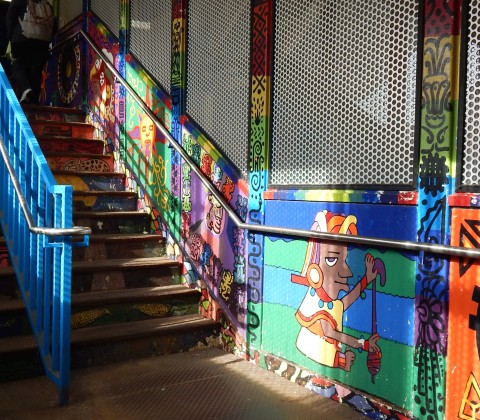
Above: 18th Street stop, Pink Line


Spring Break
Sabbatical is great for, among other things, opening up a lot of freedom to a prof’s schedule that, granted, has a lot of flexibility to begin with. Even so, the spring break schedules for my university and my kids’ school never ever align, so we jumped at the chance this year to take a big splashy trip to Italy. In addition to sites I have been able to visit before, we toured through a few towns in Emilia-Romagna that were new to us, except for the many slides of famous buildings that were included in our Renaissance architecture class many, many years ago–but which, in part, inspired the start of this academic career.
Above: base of Le Due Torri, Bologna


Sabbatical Check-In
I have spent most of my sabbatical time at home working on the editing process to finalize a manuscript that’s been underway for many years. I had the opportunity in January and February to engage in research in Washington DC that helped to finalize many details of this big project, but also lay the foundation for new work to come. Fellowships from the US Capitol Historical Society and the Smithsonian Institution supported my work in the Archives of the Architect of the Capitol, the Library of Congress, National Archives, and the Dibner Library of the History of Science and Technology. The latter is a relatively small place tucked into the Museum of American History. Its staff of two were incredibly helpful in serving up piles of resources from the nineteenth century. My main focus there was the history of the architecture and engineering professions, but it’s hard not to get sidetracked by illustrations of brick machines.


Open House Chicago (2014)
We may have missed the very first year of OHC, but have been regulars ever since. Open House Chicago is a great program organized by the Chicago Architecture Foundation that opens the doors of hundreds of buildings across the city for a big weekend of architectural indulgence. It’s very cool to see different corners of famous buildings in the Loop, but even better, I think, is the kick in the pants to get into the neighborhoods. This year, it was probably the churches of Ukrainian Village that made the biggest impression on me.
Above: St. Nicholas Ukrainian Catholic Cathedral, 1913


Plans for Washington
In January I will relocate to Washington, DC for a few months to narrow my focus on Walter-related research, starting a new project on the Capitol dome. I’m very excited to have recently received news that my application to the Dibner Library Resident Scholar Program was approved! I’m grateful for this support from the Smithsonian, which will add to the support awarded earlier by the US Capitol Historical Society for the same project.
